SAFE AI Framework
Standards and Assurance Framework for Ethical AI in Humanitarian Action
Authors: Helen McElhinney, Anjali Mazumder, Michael Tjalve, Suzy Madigan & Sarah Spencer


Operational governance for AI in humanitarian action: so deployments can be seen, compared and improved. Fill in the short form below to download.
The governance gap
Humanitarian AI is being deployed faster than the architecture needed to govern it. Systems that determine eligibility, target assistance, and mediate access to information for crisis-affected people are going live, often without adequate safeguards and rarely with meaningful input from the communities they affect.
How do we know AI is working well in humanitarian action if we cannot see, compare, or improve the systems being deployed? Every honest stakeholder is asking this. Communities AI is supposed to serve. Donors and investors funding adoption. Programme staff operating the systems. Boards holding ultimate accountability. None currently has a satisfactory answer. That is the governance gap SAFE AI closes.
The right to know
The right-to-know commitment is the organising principle of the SAFE AI Framework. It applies to the people AI systems serve, and it applies to the people who fund, build, and rely on those systems.
For communities, it means knowing when automation is in play, how decisions are being made, and how to contest them. The right of people who never interact with an AI system but are nonetheless materially affected by it is recognised. Decisions taken about people are governance acts even when those people do not encounter the system directly.
For donors, partners, and boards, it means systems can be inspected, documented, and compared on a common basis. Donors cannot fund what they cannot inspect. Organisations cannot improve what they cannot compare. The Framework operationalises the right to know in a form that makes both possible.
What’s new with AI that existing governance does not cover?
Humanitarian organisations already operate strong governance functions: data protection, safeguarding, procurement, accountability. SAFE AI builds on them. It adds what AI specifically introduces, where existing governance has not yet been built to handle it.
AI makes decisions about people who never interact with it.
Existing accountability assumes the person affected is the person using the system. With AI, often they are not. A refugee whose data passes through several agencies is affected by every system that processes it, whether or not she ever sees one. AI can exclude people silently, at scale, across multiple organisations simultaneously, faster than any existing feedback loop can catch. SAFE AI extends the right to know to people the system affects, not only people who interact with it directly.AI does not stay still after deployment.
The model updates. New capabilities are added. The context changes. Risks shift through model drift, retraining, repurposing, and behaviour change. Existing risk frameworks were built for tools that hold still. SAFE AI has Decision Gates and continuous Technical Assurance in the lifecycle, so governance keeps up with the system.The choices that determine whether AI can be governed are made before it is deployed.
How a system is built and procured shapes what can later be inspected, explained, or contested. Right-to-audit clauses, model change notification, data ownership terms, and exit rights are AI-specific contractual conditions that have to be in place before deployment. Standard procurement does not yet ask for them. SAFE AI does.
What the SAFE AI Framework does
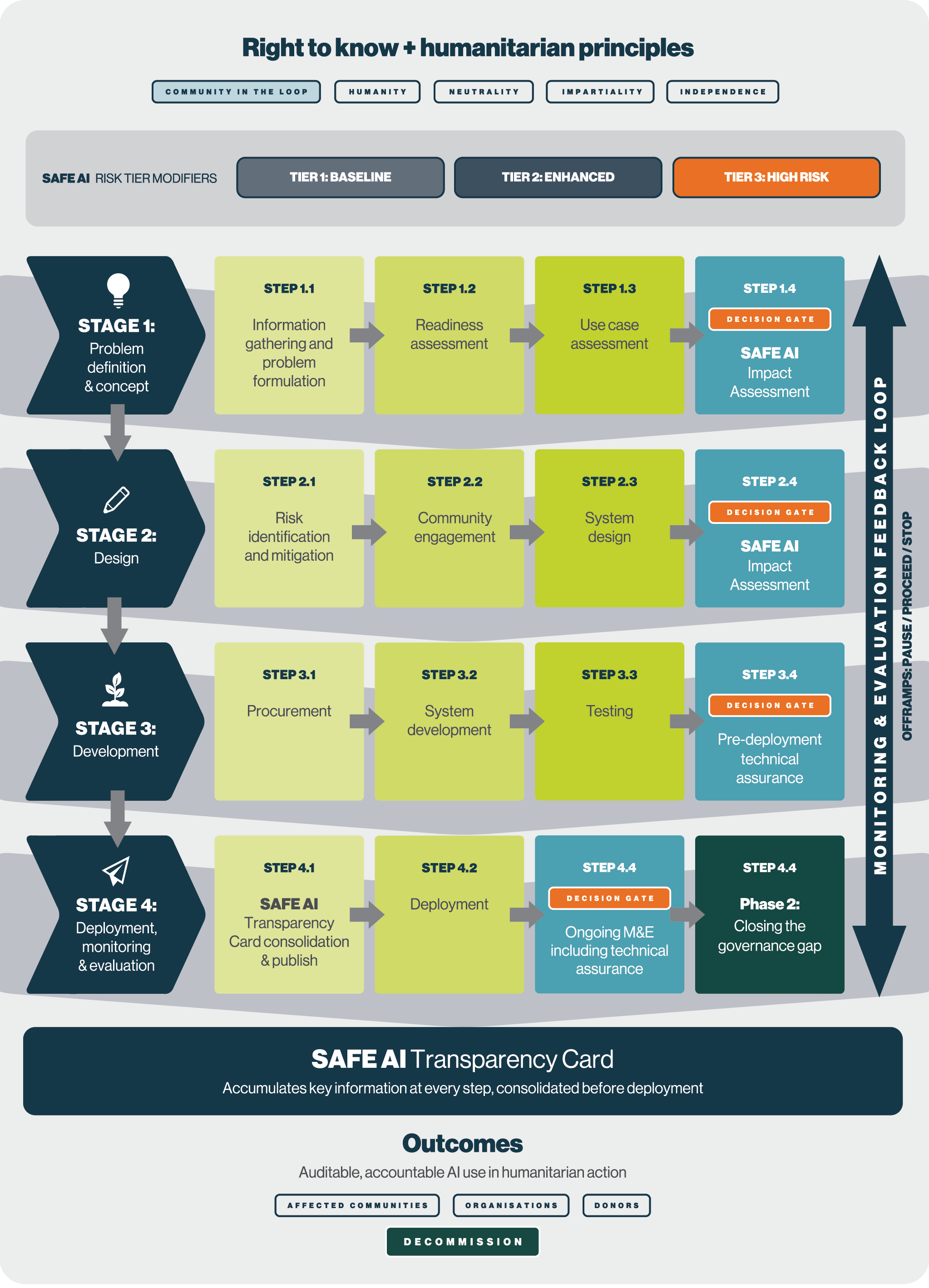
What the SAFE AI Framework does SAFE AI is governance infrastructure for humanitarian AI. It guides organisations through a four-stage Implementation Journey from problem definition to deployment and monitoring, applies a three-tier risk classification with proportionate obligations at each tier, and sets formal Decision Gates at each stage where progression is tested against humanitarian principles, protection requirements, and responsible-refusal conditions.
It does this through a set of named tools deployed at specific points in the lifecycle:
SAFE AI Onboarding and Readiness Checklist: at problem definition, to establish whether the conditions for responsible AI use exist.
SAFE AI Impact Assessment: at the first and second Decision Gates, to test whether the use case should proceed.
SAFE AI Architecture and Procurement Guides: at design and procurement, to secure right-to-audit, model change notification, data ownership, and exit conditions before deployment.
SAFE AI Technical Assurance: at development and ongoing, to verify performance against documented baselines.
SAFE AI Transparency Card: the central governance record, documenting decisions, risks, and safeguards across the lifecycle.
Community in the loop
Community participation is a lifecycle governance requirement, embedded at every stage of the Journey. Affected communities hold knowledge about how AI systems behave in their context that internal testing does not catch. The Framework treats community involvement as a structure of governance.
Where you are now, and what SAFE AI prepares you for
AI is changing fast. The systems being deployed in humanitarian action today are not the systems that will be deployed in a few years. Foundation models are getting more capable, agentic systems are moving from pilots into operations, and the pressure to adopt is rising on every side.
SAFE AI is designed to get humanitarian organisations ready. Not ready for any one technology. Ready to absorb whatever comes next, deploy it where it makes sense, refuse it where it does not, and keep the people we serve at the centre of those decisions.
Adopting the Framework is how organisations build that readiness. The four-stage Journey, the three-tier risk classification, and the named tools give organisations a working governance baseline. The Decision Gates give them the discipline to pause when something is not right. The Transparency Card gives them the record that makes each deployment defensible. Together, these are what allows an organisation to say yes to a new technology with confidence, or to say no with evidence.
For organisations with established AI governance, including UN agencies and larger INGOs that have already developed internal AI policies, ethics review processes, and compliance frameworks, SAFE AI provides comparability. A shared documentation standard and consistent risk-tiering that connect your existing practice to the wider sector. Use the tools as prompts to stress-test what you already do against what is coming.
For organisations with general governance practice but no AI-specific extension, SAFE AI is the AI lens applied through the functions you already operate. Existing data protection, safeguarding, procurement, and accountability work continues. The Framework adds what AI specifically introduces, so the governance is in place when the next deployment opportunity arrives.
For organisations building AI governance for the first time, SAFE AI provides the full operational architecture. The Journey, the tiers, and the tools give you a working baseline. You will not be starting from zero when the next wave of AI capability reaches your programmes.
The three-tier risk classification keeps obligations proportionate to what is at stake. A low-risk internal use does not carry the same governance load as a community-facing system in a conflict zone. SAFE AI scales to your risk level and your starting point, and it keeps scaling as the technology evolves.
A living standard, built with experts
The breadth of contribution is itself the case for sector-level governance: no single institution has the standing or capacity to build this alone. SAFE AI was developed in consultation with a deliberately diverse expert community – grounded in community evidence from fieldwork in Kakuma Refugee Camp with FilmAid Kenya, tested through regional dialogue with local NGOs in East Africa, and shaped by operational, technical and academic expertise from across the globe. The Framework is not the product of any single institution. It is the expression of what many have learned together about deploying AI responsibly.
What’s next
We invite humanitarian organisations to adopt the Framework, apply the tools, document their decisions, and feed the evidence back into its development.
The next stage of the work is collective: building the comparability, the sector-level evidence base, and the conditions under which humanitarian AI can be trusted by the people it is meant to serve.
Engage with SAFE AI:
Join the SAFE AI Community of Practice for sector dialogue on implementation, evidence, and refinement.
For partnership conversations, contact Founding Architect, Helen McElhinney: Helen.McElhinney@cdacnetwork.org
Adopt SAFE AI in your organisation: download the Governance Framework, Tools & Guidance.
Cite the Governance Framework as: McElhinney, H., Mazumder, A., Tjalve, M., Madigan, S. and Spencer, S. (2026). Standards and Assurance Framework for Ethical AI in Humanitarian Action (SAFE AI): A Governance Framework for Humanitarians using AI (Version 1.2). CDAC Network. https://doi.org/10.5281/zenodo.22080937
Cite the Tools & Guidance as: McElhinney, H., Mazumder, A., Tjalve, M., Madigan, S. and Spencer, S. (2026). SAFE AI Tools and Guidance (Version 1.2). CDAC Network. https://doi.org/10.5281/zenodo.22079930
Both works are licensed under CC BY 4.0.

This material has been funded by UK International Development from the UK government.