‘Nothing about us, without us’ : Why displacement camps need their own kind of journalism by DW Akadamie
This blog is part of our ‘Road to Bonn’ blog series - conversation starters ahead of the Public Forum in Bonn, Germany, on 10 December 2025, held in partnership with DW Akademie and Fondation Hirondelle. To dive into this topic more, read the Public Forum Framing Paper.
Blog written by Aarni Kuoppamäki, DW Akademie, as told to Alex Glynn (CDAC Network).
At DW Akademie, we work with our partners to strengthen free media, free expression and free societies. We train journalists to hold power accountable and create spaces where people affected by decisions can participate in shaping them. It's the foundation of any functioning democracy that those in power must answer to those they serve.
But what happens when the people you serve aren't citizens? When the basic service provider can't be voted out?
This was the question that confronted us when our South Sudan project faced a massive displacement situation about a decade ago. We went in with a traditional media development approach, focused on training East African journalists to report on displacement. What quickly realised that this needed a more context-specific approach: displacement communication.
Our work in Uganda, and later in refugee camps like Kakuma in Kenya, Cox's Bazaar in Bangladesh, and Bidibidi in Uganda, opened our eyes to a fundamental challenge. In many displacement contexts, humanitarian organisations often function as the state. They provide healthcare, education, food distribution, security – all the functions of government. Yet unlike a government, they can't be voted out. Refugees can't elect them, which fundamentally changes the power dynamic.
This creates a paradox. The Grand Bargain committed humanitarian actors to greater accountability, but how do you make an organisation accountable when the people it serves have no formal power over it?
The answer is the same one that works in democracies: communication.
Building accountability through dialogue
In Kakuma refugee camp, we worked with FilmAid Kenya to set up Sikika, a radio programme that embodies this principle. But we learned quickly that simply broadcasting information wasn't enough. Our initial needs assessment revealed that, while literacy was low and radio was the right medium, many people didn't have radios, creating a catch-22.
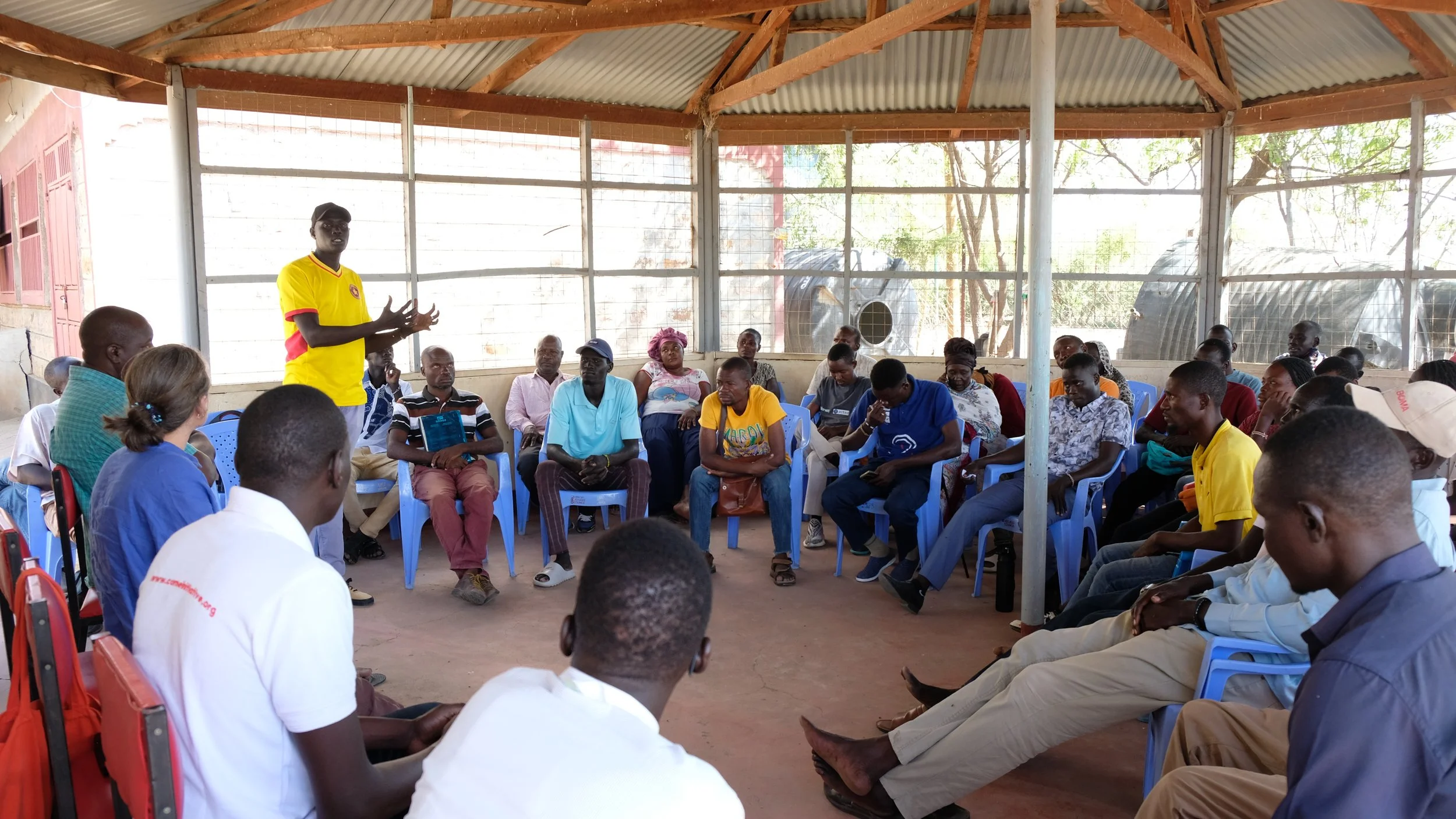
Sikika listening group. Photo: Laura Wagenknecht
To address this problem, we created listening groups. Today, our local partner COME Initiative operates around 220 listening groups across the camp (down from 290 due to resource challenges), a reality that reflects the broader crisis in humanitarian communication. Biweekly, the team produces a 40-minute programme available online and brings it to these listening groups.
One important part is that the radio team regularly joins the listening sessions. They hear directly from refugees whether their concerns have been represented, what issues matter most, and what they want to hear about.
The team of 12 people creating this content includes members from different refugee communities and host populations. This isn't humanitarian workers talking about refugees. It's refugees and host communities speaking for themselves, setting their own agenda. As the saying goes in the camps: "Nothing about us, without us."
What accountability sounds like
A reality is that people don't always want to talk about humanitarian policy. Food distribution is a critical issue right now – especially given the USAID cuts. People struggle to understand why some receive food, and others don't, and why humanitarian prioritisation isn't better communicated. But they also want to discuss how to open a business, how to obtain birth certificates, football, and music.
This is what genuine participation looks like. It might not always be what is at the top of the humanitarian agenda, but engaging people in a way they want to be engaged is a necessary part of good journalism, good communication and good humanitarian action.
The information flows both ways. Humanitarian organisations want their messages communicated, but what airs is up to the team. And crucially, information goes back to humanitarian agencies, who must then act on what they've heard. Building this trust took time – getting humanitarian organisations to truly listen remains one of our biggest challenges.
Communication is aid
What we've learned from this journey – and CDAC Network has been instrumental in helping us understand this – is that communication in humanitarian responses needs to be treated as essential infrastructure, as fundamental as water or shelter. It should be an explicit service in every response, contextualised for each situation but guided by common principles.
This isn't traditional journalism – it's displacement communication: facilitating participation, enabling dialogue, and creating accountability in environments where formal democratic mechanisms don't exist.
As funding dwindles and trust erodes in crisis information systems, the question becomes more urgent: how do we ensure people affected by crises aren't just recipients of aid, but active participants in the decisions that shape their lives?
That's the conversation we need to have –and one I'm looking forward to exploring at CDAC's Public Forum this week.